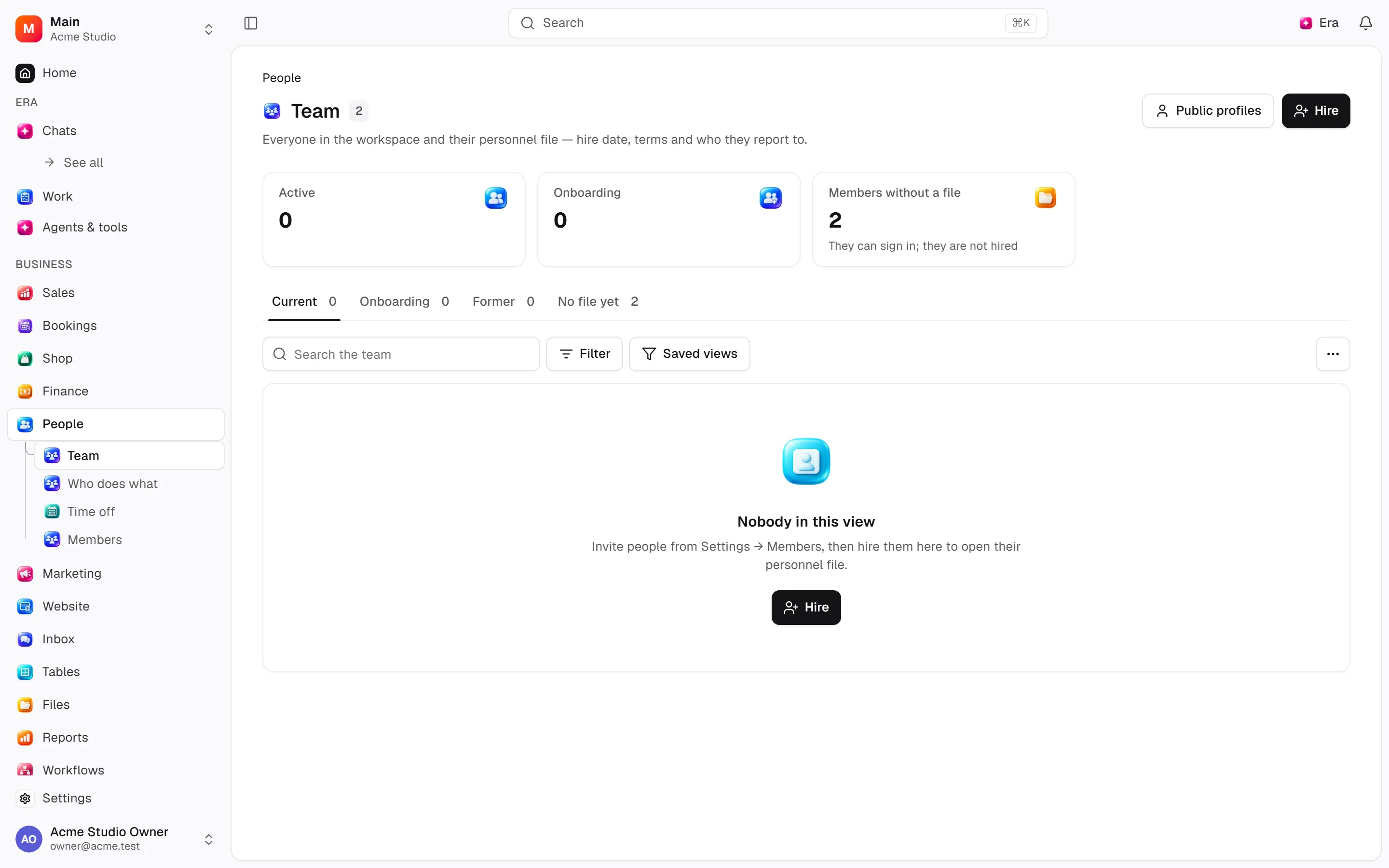
Team and employee profiles
Managers maintain personnel and service relationships. Employee profiles are separate from application membership.
Managers maintain personnel and service relationships. Employee profiles are separate from application membership.
Where to find it
Web: open People. Desktop: Business → People, using the same record paths. Disabled modules or missing read permission remove the navigation entry.
| Screen / tab | Web path | Usage | Desktop |
|---|---|---|---|
| Team | /team | List, view or tab | Native screen |
| Staff profiles | /team/profiles | List, view or tab | Native screen |
| Person not found | /team/[user] | Record or editor | Native screen |
Record tabs and panels
These contributions appear when their modules are enabled and permitted, alongside the record’s own tabs. Check module/permission state if missing.
| Area | Kind | Owning module |
|---|---|---|
| Open tasks | Panel | ai |
| Upcoming appointments | Panel | appointments |
| Time off | Tab | availability |
| Services | Tab | availability |
| Working hours | Tab | availability |
| Open leads | Panel | crm |
| Customers they own | Panel | customers |
| Open home visits | Panel | field_service |
| Unresolved conversations | Panel | inbox |
| Open quotes | Panel | quotes |
| Profile | Tab | organizations |
| Access | Tab | security_access |
| History | Tab | activity |
Start working
Step 1
Open an employee in Team.
Step 2
Edit profile and employment status.
Step 3
Review services/hours.
Step 4
Inspect handover panels before departure.
Settings
Option-by-option configuration and screen paths: Settings guide.
There is no separate settings route; the guide distinguishes record options from declared defaults.
Permissions and limits
Before you start
Profiles do not grant access; Members owns invitations/roles. There are no departments and no timesheets: the team is one list, and the reporting line is its only structure.
Role capabilities: Read (read), Write (write), Manage (manage), Export (export), Comment (comment).
Own-record restrictions apply equally to lists, records and Era. Record state or missing data can refuse an otherwise permitted action.
Ask Era
Show this employee’s open records needing handover.
Select relevant records for Era context. Era respects modules/roles; external or confirmation-sensitive work can stop for approval. Use era tools in the terminal to inspect currently available tools.
Automation and events
These declared events are available to module-event triggers. Subscribing does not configure the next operation; choose recipients, conditions and actions separately.
Operation details
The inventory includes record, configuration, visitor and background flows. IDs support Era/automation; not every row is a menu button. Asterisks mark required inputs. Unmapped rows do not imply a visible control.
| Operation and ID | Inputs | Permission | Screen or flow |
|---|---|---|---|
Hire · employees.hire | Member *, Hire date *, Employment type, Skip onboarding, Work phone, Emergency contact, Emergency phone, Notes | Manage | /team, /team/[user] |
Edit employment details · employees.update | Member *, Hire date, Employment type, Work phone, Emergency contact, Emergency phone, Notes | Manage | /team, /team/[user] |
Finish onboarding · employees.activate | Member * | Manage | /team/[user] |
End employment · employees.end_employment | Member *, Last day *, Reason *, Note | Manage | /team/[user] |
Related guides
Settings
Options, screen paths and defaults.
Workflows
Operations managers connect triggered blocks on a canvas with conditions, loops and approval waits.
People
People — modules and detailed settings
Technical sources
packages/os-kernel/src/modules/employees.ts, packages/os-kernel/src/modules/index.ts, apps/studio/lib/os/navigation.ts, apps/studio/lib/os/settings-groups.ts, apps/era-station/apps/web/src/era/business/screens.ts.